Andy Adamson interview: the latest web technology
11 February 2022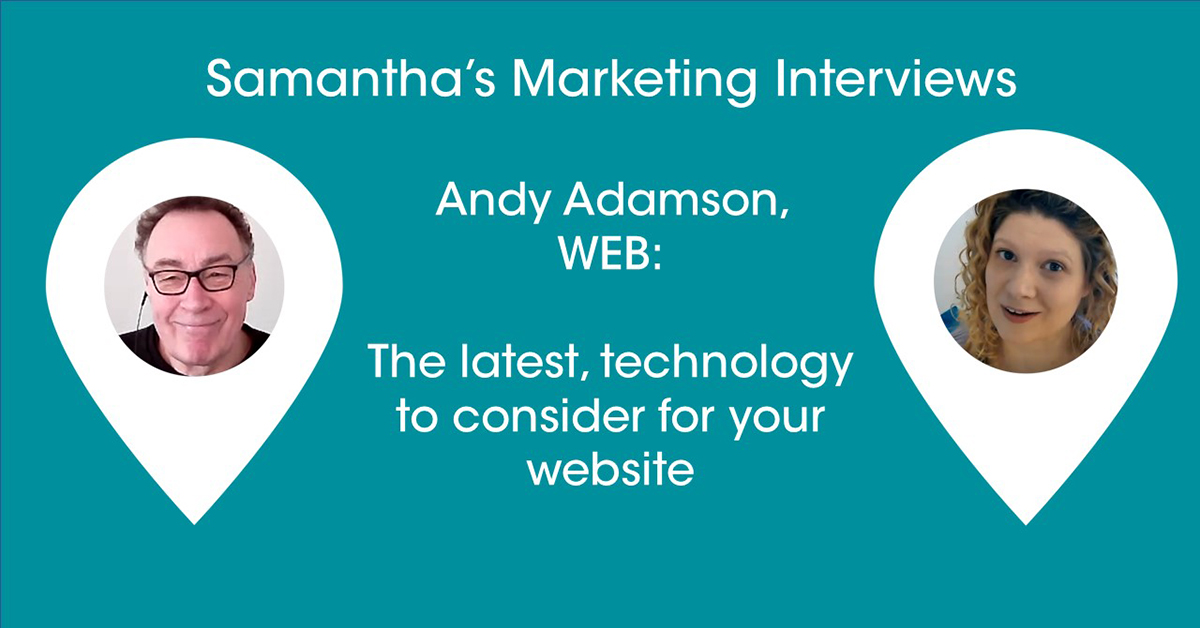
In Samantha’s latest interview, web technology expert Andy Adamson spoke about the latest technology within websites. Andy shared his latest work including AI and chatbots. He explained what he sees as the next two big disruptive technologies: artificial intelligence and blockchain. Check out this interview to know what technologies to look out for in the coming years and how to keep your business competitive.
Andy is a web technology expert and founded WEB in 1995 at the beginning of the internet revolution. He’s carried on as he started out, as an early adopter and creator of the most up to date web technologies.
Andy’s links:
Watch the video here or read the transcript below if you prefer
Transcript:
Samantha Tonge: Hi, it's Samantha Tonge from Labrakita Marketing here again, speaking with yet another expert. We've got Andy Adamson here today. And what we're going to be speaking about generally, is the latest technology within websites and related topics. So Andy, over to you. Can you introduce yourself, please?
Andy Adamson: Yeah, I can. Thank you, first of all, for having me. I guess, the first thing to say is that we've kind of changed what we do over the last four years or so. So we've niched into the legal sector and we create digital products. Digital products are anything from websites through software applications, all the way to machine learning, for example chatbots, which is a big focus for us at the moment. So it's kind of anything that can be delivered through a web browser, I would say. Our job is quite challenging, because everything we do, needs to be intuitive. And as designers and engineers, I think we need to give people the tools to complete a given task and then get out of the way. That's kind of what we do in a nutshell.
Samantha: So, ultimately, you create efficiencies for your clients, right?
Andy: Yeah, yeah, that's a good way of putting it.
Samantha: Right. So... Okay. I guess, things are changing constantly in that field, especially what's available, and what we can do. So as marketers, what are some things that we need to think about that is available now? You mentioned chatbots. That might be a good place to start. And just anything that we need to start thinking about integrating with our technologies.
Andy: Yeah, well. Do you know what? I think we work in slightly different spaces, but we're doing very similar things. We're both helping companies get where they want to be. And I guess our bit starts when you finish or, you know, you lead the way in what we're doing. And in our sector alone, I guess, Samantha, we've got quite a lot of technology that's around us already. You know, if you think about the project management tools that we've just got used to, you know, things like Asana, Trello, Monday, Teamwork, Productive. There are all of these great applications that help us do what we need to do. And then if you look at the accounting bit, you know, you've got FreeAgent, Xero, QuickBooks and everything. And then you also got Zoom, Teams, and then a fantastic tool called Slack. All of these, they do help us do what we're doing. And that's what technology is all about. I often hear people talk about digital transformation. And I guess in that respect, there are two things I think that are really going to transform what we do. One of them is happening already, and that's artificial intelligence. And the second one is blockchain.
Samantha: Yeah.
Andy: Blockchain is something that, I think, is alien to most people. It's pretty scary. But that's emerging as something really quite interesting. You know, I was just looking at some stats recently. In 2019 alone, there were over a thousand tech start-ups in blockchain.
Samantha: Oh wow.
Andy: Yeah, exactly. And that's going to lead to something. There's a lot happening around the world and I think that that number is going to grow. But I guess, you know, understanding what blockchain is, is the hard bit. It's... I'll maybe just describe briefly what it actually does.
Samantha: Yeah. I haven't the faintest idea, so if you could...?
Andy: Because it's something we're just looking at, at the moment, but it is slightly alien to most. It's kind of a method. A blockchain is a system of recording information in a way that makes it difficult to change or hack or cheat the system. And that's what's appealing to people, I think. And these blockchains are stored across a network of computers. So there's no one person who actually owns the system as such, but it's accessible to everybody. And you know, you might hear it referred to as a distributed network. But yeah, the blockchain's first big killer app really is the Bitcoin, isn't it? And everybody has heard of Bitcoin, you know, that has really become quite desirable, because it can't be copied and it's a good way of stopping fraud. So these are, you know, person to person transactions with no banks involved, which I think people like. You know, what I see happening in the future... I think, you know what, I think we're going to start seeing even house sales in the blockchain. The blockchain element would be the deeds of that house, or it could be several conditions. And that will be handled between the purchaser and the seller, there'd be nobody else involved, and it'd be quicker.
Samantha: That's an interesting concept!
Andy: So, yeah, it's interesting. There's going to be a lot happening in that space, I think, over the coming years. In fact, the Law Society has just produced its second edition of its regulatory compliance on blockchain. So that's a good indication of what the general feeling is, you know. I think, at the moment, we're just trying to work out how artificial intelligence can fit in with us. And as you said, chatbots, which is really something that's pretty powerful. I honestly think it's going to change all of our jobs, and you know, across the board. It's not going to take our jobs away, which I think is the fear for most people.
Samantha: Yeah.
Andy: But it's going to help us do what we do. And, you know, certainly, when you look at your field, marketing, and particularly that online space where there's lots of analytics and data to look at...
Samantha: Yeah.
Andy: ...that's where artificial intelligence will come in and help it.
Samantha: Yeah. It will make my life a lot easier.
Andy: Yeah, exactly. And the reporting of all that.
Samantha: It analyses stuff and tells me: "Oh, you need to do more of this."
Andy: Yes, yeah. It's, yeah. I think mobile phones for example, they have quite a big impact on how we consume information and how we entertain ourselves, how we buy products, but this is much bigger than that. This is a significant shift in my view. I mean, it can reason, it can learn, and it can recognise patterns and things. So, you know, it's already there in software applications and robots. But it's really about decision-making and problem-solving for anyone that's willing to work with it. There's a lot of opportunities, I think. It's a real disruptive technology. And it's weird, that it's been around for quite some time. You know, Google first released their AI engine, a thing called RankBrain, in 2015, which was helping Google to rank websites. So it was looking for content, based on the search terms, and it was bumping them up above others that had fewer of those search terms. You know all of this.
Samantha: Yeah, yeah.
Andy: But that was 2015. And they've learned a lot in that time, with their products, especially with their AI products, which are very good. You can actually test it yourself. You know, if you pick up your phone and say, for example… do a voice search for, say: "Who is Barack Obama?" It'll come back and tell you. And then if you ask it another question, for example: "Does he have a dog?" It'll come back and tell you: "Yes, he's got a dog called Sunny." But I didn't say: 'Does Barack Obama have a dog?"
Samantha: Yeah. Ok. So it knew from the conversation.
Andy: Yes. So the machine learning elements of that... Now, that, actually, for a machine is really clever. And that's the bit that really excites us. You know, I remember, gosh, years ago we used to work with The Lowry in Salford, a really big theatre and art space. And I remember that I was really pleased when we got the tender. And I just sort of said: "Can I sit in the box office and just listen to what people are asking?" So, you see, I tried to learn about the organisation. I was there for an hour or so, and people were getting asked the same questions over and over, but the way they were being answered was with great knowledge. And they were saying: "Well, this show is about this, and, you know, you can buy tickets for it, and it's got a little bit of humour, it's quite…”, you know. And I was like: "Oh God, we can never do that on a website!" And I got kind of depressed. But with chatbots, I think we're getting to a stage where a chatbot can respond to questions with the right answers so long as you tell it what those answers are.
Samantha: Yeah. So that's the trick?
Andy: Yeah, I mean, they're clever but they're really stupid. You know, we released a chatbot… When was that? Two years ago maybe? And it was for a kids charity, a mental health charity in Manchester. It was to try and help kids who were in a bit of a crisis. They could go to the chatbot and they could just say: "I'm feeling depressed or feeling tired or feeling low." And it would know what to say back. And it knew what to say back, because we got the kids themselves, who have come through the process, to programme it to say: "Right, if someone says this, what should...?" You tell it, you know? So it wasn't diagnosing, it was just giving them information on things that you can do. For example, if you can't sleep, you know, these are some of the things that might help you. Now, that is a great way of just making a small impact on people's lives. But you take that to customer service, if it's done correctly. Ohhh! We're good.
Samantha: Yes.
Andy: That's the bit that excites me.
Samantha: See, from my perspective, it could potentially, you know, qualify leads before it gets to you.
Andy: Exactly. It's putting them straight into your CRM system and making appointments in your Outlook Calendar, or whichever system you use.
Samantha: Really?
Andy: Yeah. It can integrate with Facebook and all your social media channels. Yeah... it's powerful stuff. But the problem with these things is that… You know, we did a prototype for an online will application, and there's about 4,500 questions it can answer, but it's still not enough.
Samantha: Okay.
Andy: We were just in the final testing stages of an employment contract chatbot that can ask you questions and then generates legally binding employment contract.
Samantha: Ooh.
Andy: But it's just starting out, and it's really stupid. It is. It's terrible. So we've been working with a lawyer, and it just needs more and more questions that it can answer. And, you know, the whole homeworking thing… So you also update it with homeworking data protection, all these sorts of things. It's really powerful.
Samantha: Yeah, it sounds really exciting, from my point of view. I've got ideas already of how to use it for my clients and myself.
Andy: Yeah. Yeah.
Samantha: It sounds amazing.
Andy: Well, I mean, I think, the good thing is that they can do multiple conversations at one time. There's no limit, effectively, and they can do it 24 hours a day. So you know, the sector we're in, in the legal sector, the great thing is, that people can, if they wanted to get employment contracts, or whatever contract it might be, whenever they want, when it suits them. If you're a business owner, or, you know, if you're doing shift work, or whatever that might be, you've got access to legal services when you need them. That's the grand plan.
Samantha: Yeah, it sounds brilliant.
Andy: Yeah.
Samantha: And is...? I mean, you've mentioned, that you do browser-based stuff, which brings me onto another thing. Because the lines are very much being blurred between applications and websites now, aren't they?
Andy: Yeah, definitely. Yeah, absolutely. I couldn't agree more. You know, that's what we started calling digital products now. Because a website on its own, I would say it is probably not... Well, I suppose it's a credentials thing. But when you start stitching in a CRM system, your appointments calendar, or integrating any other back-office databases, so people can...
Samantha: Marketing automation...
Andy: Marketing automation. Yeah, exactly.
Samantha: Yeah.
Andy: Yeah. Which, I keep hearing people, you know, old-school people complaining about, but actually… it just makes sense.
Samantha: Absolutely.
Andy: You know, I think the only challenge that automation brings is this… shouting, you know? I kind of worry a little bit about social platforms becoming flooded with voices. And, you know, standing out amongst that lot is becoming a real challenge.
Samantha: Yes.
Andy: Maybe the Metaverse will change that.
Samantha: Hmmm… I’m not convinced.
Andy: Yeah. I don't know either. Yes.
Samantha: Yeah, that's very true. And getting your voice heard... I find that increasingly difficult on Facebook, from a personal point of view. Because I've got two accounts: I've got my professional Facebook account and my personal account. I find myself looking at it less and less, because I just keep seeing the same posts over and over. And I'm getting bored. I think there was this recent news about daily users dropping. Might that be because they actually need to improve their automation?
Andy: Yeah, definitely. And I think the algorithms that have been used, will get another AI application. It is that they are still learning, I think, in many respects. You know, when you start looking at, particularly, I notice this on Instagram… You know, you start looking at certain types of posts, and then it gives you more of those. I find that quite frustrating actually, because I don't think I'm much of a..., but I got quite an eclectic interest in things, you know?
Samantha: Yeah.
Andy: You know, think about architecture, design, fashion, furniture, interior, you know, all of these facets that, I don't think I'm that different from others. But, you know, when I start looking at certain things, I get flooded with other stuff. And I go: "No!" So that's a big turn-off. But hopefully, they'll be learning from that, if they're listening to people. And sure, as you say, if people are dropping off, then they are going to encounter troubles.
Samantha: Which is hitting their advertising revenue, big time, so...
Andy: Yeah.
Samantha: So yeah, you would think they would improve. Yeah, I think that generally, it is quite hard to cut across the noise in marketing. But yeah, you are right, in social media space, it's becoming more difficult, I think.
Andy: Yeah.
Samantha: I think a lot of the time when people think about social media marketing, they think about the organic posts, which are just the ones that you put out there for your connections to see. But it's the paid for, that gets the most views for obvious reasons. So yeah, if that isn't in your budget, just as an aside, since we're talking about it, it's probably worth considering. Yeah, so... Do you think there are other technologies that we all ought to think about, because it will make our lives easier today? That's, you know, available that we ought to look at?
Andy: Yeah, that's a really good question. I think... Yeah, it's really hard to answer that question in a sense, because, you know, what we've got, some of the technology we've talked about, say, project management tools, or accounting tools or the communications tools, they're kind of supporting what we do.
Samantha: Yeah.
Andy: And what we really need is a disrupter. You know, blockchain is going to be a disrupter. Artificial intelligence, in my view, is a disrupter. But it's how do you use those, I think, that’s the secret. And, you know, an easy one for us to pick on was chatbot, because they're relatively straightforward to do.
Samantha: Right.
Andy: Yeah, that's a good question actually. I'm not sure I can give you an answer and say: “You should be using this technology now”. But what I would do is definitely keep an eye on Artificial Intelligence, and how that could impact on what you're doing. Because, you know, we've got support technology, and we've got disrupting technology, and AI is disrupting. It can really help us. And don't worry, it's not going to take any people's jobs away, it's going to help people use their brain in a much more creative way, which is what we're good at, you know. Data crunching? Pfuh. No.
Samantha: Yeah.
Andy: You know, there's a small section of society, who have got that kind of brain. And well, you know, it can be done by machines. And I would say that's it, you know, so, for you, I guess, it would be analytics and data analysis. You know, if you want to say: "Right, I need to understand a, b and k, these elements of the full A to Zed, those are my top picks. How can artificial intelligence help with that?" You know, right now, I can't think of an AI product that's out there, that's working in your sector, and is not very expensive. You know, at the moment artificial intelligence is quite expensive to implement, but because of the machine learning component, the sooner you implement it, the better it's going to be.
Samantha: It'll save you money in the long run.
Andy: Oh God yeah. And it will also put you ahead of your competitors. You know, I can see a time where there are firms who will specialise in AI technology and automation. Probably just because they had an investment in it in the first place. And they will be flooded with other companies like them, saying: "Can you just automate this process and give us our data back?" You know, I can see that, for example, a marketing data analytics using a marketing company who focuses on analysing this amazing amount of data we've got. I guess you're familiar with, obviously you'll be familiar with Google Analytics. You know, they've got Data Studio to try and make it easier, but I’m not sure they've actually managed to achieve that. So you know, what we want to do is for this application to state to us and report back to us every week, in easy terms things that everyone can understand.
Samantha: Yeah.
Andy: You've achieved this because of this, this and this.
Samantha: Yeah.
Andy: And, you know, some of the analytics we're getting at the moment, they are all a bit vague to me, you know, I don't know how understandable they are to companies that we work with. You know, we've got to sit in between, and interpret all that for them in a way that they can understand and it's not being disrespectful to the end-client. It's just... it's what we do. You know, it's kind of...
Samantha: Yeah, yeah, completely, completely. Yeah.
Andy: Yeah. So it's... once you get a question...
Samantha: It requires skill. It's not that easy.
Andy: Yeah. So I can't give you a definitive answer right now and say that you should be using this technology. But I'll say what I would do. I would start investigating how artificial intelligence can help you in your own business.
Samantha: That does sound like good advice. Yeah.
Andy: You know, that's going to be massive. And then once you've got used to that, blockchain will come along and change everything again. Hahaha
Samantha: Yeah, sounds really interesting. I mean, you were talking about it in a way already and I guess you have kind of covered this. But I was going to ask about the future. What do you see that there's going to be going on in 5-10 years’ time? So I guess a lot of that's going to involve artificial intelligence and blockchain. Is that the answer really or was there anything else that you think is coming along that we need to be aware of?
Andy: No, not that I've spotted. I'm kind of... I don't think we can take anything else at the moment. Certainly my brain cannot! But… definitely, blockchain will be an interesting one, you know, there are so many tech start-ups. And they're all working away on different systems and methods and better ways of doing things. And I think it's going to be popular. Because it's a peer-to-peer thing, and it cuts out layers of organisations who seem to be taking money from that transaction where it’s not really needed.
Samantha: Yeah. Sounds like it's an added layer of security as well, because...
Andy: Exactly, that's exactly what it is.
Samantha: …it is a huge area, and it sounds like that blockchain might be some of the answer, anyway.
Andy: Yeah, I think so. And security, you know, I think we've all become very aware of hacking. That has really grown. You know, when I think about when we were working 10 years ago, it was pretty rare that we would see something. Now it's commonplace, and we're expecting it, you know, we just anticipate it. You know, we've got our own dedicated servers and the company that actually host them for us, got a dedicated security team as well.
Samantha: Yeah.
Andy: And as part of their organisation, they have lecture theatres, so they get graduates that are coming up, who know all the latest stuff, but then start learning what actually is happening and there's more layers of security that need to go on things. It's a real worry, actually.
Samantha: It's shocking, how some very large companies have been caught out when they, you know, I mean, even on setups that I'll be, you know, if I get a ransomware attack, I'll be back, up and running within 24 hours, because...
Andy: Oh really? Good for you!
Samantha: Yeah. You know, it's all backed up, not just on my system. Not just on, you know, Office 365, it's on like another separate system so that, you know, the ransomware... it, you know, not everything's going to get caught out in it. You just think: "Why are huge companies not investing in it, when it stops them doing business?" Like TNT was ground to a halt for a long time and individuals were having to, you know, use their mobile phone contacts to try and figure out where lorries were and stuff. And you just think: ”it's such a nuisance”, so it's interesting that, you know, that might be another part of the solution.
Andy: Yeah, definitely. Yeah, I think it is amazing how many high-profile organisations just haven't really done what they should do. And I think, you know, if you think about it, you've got network engineers, who will buy a certain amount of protective kit: firewalls, and what have you. And these products, you know, these boxes get taken out of the box, and they get plugged into the network, and use only the standard protocols to set these things up. And people just work with those standard protocols. So if you're a hacker who studied this stuff, from the guy who's actually fitted it, goes: "Right, I know that 85% of people just use these out-of-the-box settings when they're doing these things." And then there's a way in there and then once they're in there, they can wreak havoc. And you know, these guys, I don't know, it's interesting. I've worked with software engineers for... God... quite a long time. And they're an interesting group of people, they're very ethical people. It's pretty rare that you get someone who goes a bit rogue, but on the whole, you know, you get what we call ethical hackers who will try and break into a place and these people are paid a lot of money to do it.
Samantha: Yeah.
Andy: And, you know, a little study of Computing and Computer Science and Engineering from the same place, same universities, they will know it all. And another problem is that open-source content management systems, what have you... open-source platforms became very popular, because effectively, we're free. But the problem with those open sources is that all the source code is out there, so anyone can see it and it is easy to break into.
Samantha: Right.
Andy: And then, okay, so, someone closes the door, but you can still get that closed door and open it again, you know?
Samantha: Right.
Andy: Do you know what I mean? So it's sort of a constant battle. Yeah, I think security is a real, real concern. And, you know, often when people commission software, they get what they call a minimum viable product, MVP. And that actually is often the one that stays there, because of the cost. You know, writing software is very, very expensive. Engineers are expensive, because there is not enough of them around.
Samantha: Yeah.
Andy: Yeah, so... Adding all that layer of security in there, it's a lot. You know, an extra cost, or what is seen as an extra cost, but it's pretty vital. But I think, you know, things are changing now. I started to see the legislative bodies putting standards down, you know, cyber essentials, and all these sorts of standards, and ISO standards, which are very good things to do, I think. I think, once you start using those methods, it makes it a bit safer. But more importantly, I think it draws to attention, what you're doing with data and what you're doing with information. You know, we've had clients in the past who just gathered loads of data. You know, when you're just filling out a form, buying a product, you know, they were asking them all sorts of questions but we're never actually going to use that data. I remember working with a theatre down south, and they had this sort of internal discussion saying: “We've got all these massive databases of people, but we're not using that data”. So they actually got rid of it. They just use the name and email address, because that's how they communicate. They don't send them anything through the post anymore, unless they specifically ask for it. So yeah, I think we're starting to think a little bit more about a broader thing. You know, there's always this thing that it's a safe place to be, but it never was.
Samantha: Yeah.
Andy: You know, the internet is this great thing that always works. Well, yeah, it does, but it does break and there are breaches and it is run by human beings for the most part. So yeah.
Samantha: And even when it's not, it's things that were made by human beings, so...
Andy: Yeah, yeah, exactly. Yeah. What goes in, comes out.
Samantha: Yeah. It sounds like, generally, the overall message is: we should be keeping an eye on what's out there, what's available, what's coming up and think about getting ahead of the competition.
Andy: Yeah.
Samantha: And generally, which I think is a good thing anyway, but yeah, in terms of technology as well, we need to be thinking long-term, not short-term.
Andy: Yeah, definitely. And artificial intelligence, to me is the way to go and see how you can use that in your business and in what you do. And, you know, just to cover that again, what it does is that it allows you to use your brain in a way that is the best part, the creative bit, you know. As you know, when you're working for lots of different companies and clients, you get a lot of noise and experience and, actually, you know when to break the rules, and when not to break the rules. You know, you kind of feel your way through all of that. You make mistakes on the journey, and you learn and that's correct. And that's what technology should be doing. It should allow you time to really think strategically about what your clients want and how to get them there.
Samantha: Yeah.
Andy: That's the good stuff, you know?
Samantha: Yeah.
Andy: All the other, boring tasks can be done by machines.
Samantha: I think we all sought sometimes anything that can help us get on with the day job.
Andy: Yeah. And it's the speed.
Samantha: Yeah. Yeah. Absolutely.
Andy: If you think about an AI application that can read tens of thousands of documents in minutes.
Samantha: Yeah.
Andy: And it can know every single word. It can spot patterns in those texts that you tell it to look for.
Samantha: Yeah, yeah. Sounds brilliant. So yeah, thank you very much for that. It's a lot of really useful information, things that we need to… well, actually, to be fair, lots of industries, but in turn, marketers need to start thinking about how to integrate some of this stuff. So it's brilliant. Thank you very much. And before I go, I always like to ask: “Do you have anything to plug at the moment?”
Andy: Do I have anything to plug? I think I've already talked about the work we're doing with chatbots. That's the stuff that's really powerful.
Samantha: If you need a chatbot, especially if you're in the legal sphere. Speak to Andy.
Andy: That's it. Yeah. Or if you've got loads of contracts that you need automating then, yeah, that's what we've been doing. So yeah, that's my plug. Thank you.
Samantha: All good. I will upload this to my YouTube channel, and this will all be going up on my website as well, and I will make sure that Andy's links are there. So check them out. Yeah, thank you very much.
Andy: My pleasure!
Samantha: And yeah, goodbye, everybody! Thank you.
Andy: Thank you.
If you want help with advanced technology such as web chatbots or automated contracts, especially if you work in the legal sphere call him on 0131 454 3311 or email at andrew.adamson@madewithweb.com
If you need any help with your marketing, call me on 07791 521439 or email me at samantha@labrakita.co.uk
Interviewer: Samantha Tonge, Managing Director, Labrakita Marketing