Interview with Gica Trierweiler: B2B Brands
25 November 2022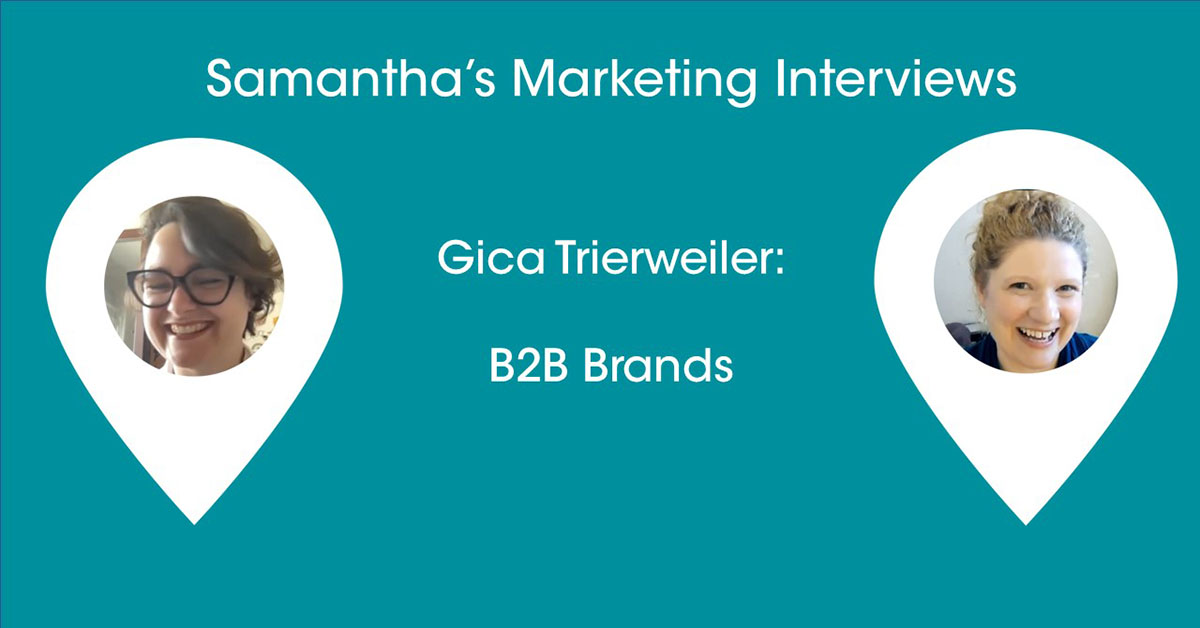
Samantha interviewed experienced B2B Head of Marketing Gica Trierweiler about B2B brands. They spoke about making B2B marketing brands exciting to their customers and how that can help them boost their sales. Find out why emotions play an important role in B2B communications.
‘Saving people from boring brands and useless advertising’ is not a bad goal. But when you listen to Gica Trierweiler, you realise that she actually means it. Her enthusiasm is contagious, and her clever insights reveal what makes brands shine or fail? Spoiler alert: it is not what you think. So, when was the last time you reassessed your brand? Have you even thought about what your brand is? If you are reading this, thinking: “I’m B2B, brand is not important”, then you better watch this (or read the transcript if you prefer). As Gica states, you are always selling to a person, a human being with emotions and desires, even if this human sits in a company office. Samantha and Gica discuss brands, why it’s important to be consistent, and how working on your brand can bring you closer to your customers and help you build a community. Trust us, you can’t afford to miss it!
Gica's LinkedIn
Transcript:
Samantha Tonge: Hi everyone, it's Samantha from Labrakita Marketing again. We have Gica here today. And we're going to be talking about B2B marketing. So Gica, can you tell us a little bit about yourself?
Gica Trierweiler: I definitely can. So, in a nutshell, cheese is my spirit animal. Not all of my tattoos have meanings. And what I do for life is saving people from boring brands and useless advertising.
Samantha: Excellent. Excellent. Yeah, the worst thing a brand can be is boring.
Gica: Oh, yeah.
Samantha: And that does 100% include B2B.
Gica: 100%. Maybe a thousand percent even.
Samantha: Yeah. I think one of the problems I had, especially when I was client-side, which you may have come across as well, was trying to explain to senior corporate level that you can use emotion. Things can be amusing, you can be exciting and still be a serious brand.
Gica: Samantha, definitely! This is something that really bothers me, especially when it comes to B2B. But first things first. I don't know if everybody is informed about the difference between B2B and B2C. So, when you have B2C, you have a business to consumer. Meaning that you are a brand that is selling straight to the end user, or simply, people. For instance, I don't know, you're a clothes brand, or whatever. And then you are selling to the people who are going to wear your brand. And when we're talking about B2B, then it's business to business, which means that you are selling something that another company will use. And somehow, there is this very tragic idea that when it comes to B2B brands: "No, no, no. No, we are not B2C, we should be like, more serious, more conservative, because, you know, this is corporate communication," and all that. And I really couldn't have a more different opinion about that, because, in the end, you’re still selling to a person. Regardless, whether you're selling directly to your consumer, or to a person that is signing the check to contract, or who buys something from another business. It's still a person doing that. And everybody has emotions. So why would you have a super greyish, and neutral, and absolutely depersonalised brand? Why? Why? Why, Samantha?
Samantha: I think the reason is that there's this belief that in business-to-business, people are making very rational decisions. Therefore, there, it's based purely on facts. But that's not the reality of human beings. That's not how we function.
Gica: We love facts. Yes, thank you very much. Facts are important. Facts can help us make better decisions and all that. Definitely. But it's so sterile when you just pile up a bunch of facts, or product features, or whatever. And then it's like: "Yeah, okay. But what's the story you want to tell?" Right? Because, again, it doesn't matter if you are B2C or B2B. Regardless of that, you want to keep your customers, right? You want them to come back. You want them to work for you, doing some word of mouth. You want them to engage with your brand. So how are you going to do that, if you can only talk in numbers? Or if you can only talk in features? This is so boring.
Samantha: Yes. On my word. Yes. And it's not just your existing customers and engaging with them either. It's getting their attention in the first place.
Gica: Exactly.
Samantha: You know, you've got to get someone's attention for them to even look at the facts and figures. People are bombarded, including in business-to-business, including very technical people, they're bombarded with messages every single day. Why should they look at you? Why should they look in more detail at your facts and figures?
Gica: Yeah. And most probably, they are receiving thousands of messages from other companies that look exactly the same. Because this is the norm, yeah? You have this sort of vocabulary. And what I hate the most is like: "Okay, we need to put more emotions here." So instead of: "Look at this 4K beamer", or whatever, they change it to: "Look at this awesome, 4K beamer". It's like: "Nah, come on."
Samantha: There's, a little bit more to it than that.
Gica: I'm so tired of awesome. "This is awesome, that..." And then disruptive: "This disruptive, that..." No, seriously, like: "Tell me more. Tell me how my company will be impacted. How I, myself will be impacted if I am working with your company." Right? And there is also something else, Samantha, that I can see, and it’s... Again, as we were talking before, it's not only about engaging your people, but it's also about making them to be with us, to realise that we do exist as a company. And, you know, this is something that is trending. I mean, it's a macro trend. So it's been more than fifteen years already that we've been constantly talking about community building, right? You don't want just a customer. You want to nurture this relationship, because there's so much added value into that, you know? People start to... Yeah, it's like... What was her name...? Faith Popcorn, the super, "fortune teller of business", she was the mother of trends and stuff.
Samantha: Okay. Faith Popcorn? I don't think I've heard of her.
Gica: Faith Popcorn. Yeah. No, many years ago, I mean, decades already, maybe thirty years even or something like that. She was like: "No, all the businesses, they all have to take care of this." And then I remember one of the macro trends, which I don’t think I’ll ever forget. One is cocooning. It's the need for people to be like, in a pod, and to be embraced. And the other one is belonging. So we want to belong. Definitely.
What are we doing on every social media channel? It's like: "Hey, I also like this. Yeah, I also wear the same outfit style. Oh, yes. I also have a French Bulldog." You know? We are, all the time, trying to belong to certain communities and your business can do the same, you know? So yeah, I also buy from them, so that makes me special or that makes me look very trendy, or trustworthy, or very responsible, or, or, or... So, yeah. This is so important.
Samantha: As a topic that comes up again and again in my videos. You need to start with the basics. You need to understand who your customers are, in order to understand how you benefit them, and what sort of emotions are coming up in the specific situation where they're going to be interested in your product, or come across your product or service. It's getting those basics right. It's understanding, you know, your segmentation, etc. It's the basic segmenting your market, targeting, positioning.
Gica: Fundamental. Absolutely. Because those are the most common mistakes I would say. First one is: "I don't know who I am as a company." And: "I don't know who my customers are." Normally they come together, in a combo, which is very sad. And then what you can see happening... And it's... Yeah. When you don't have this understanding of who you are as a company in terms of: "What difference are you making there?" You know? "What is the impact you are bringing to the market?" And here I'm not talking about social impact, although I do believe social impact should be on the agendas of every company. But okay, "What's the difference you make?", and to know that you have to understand what your customers need, because you will have to provide this for them. This is the most beautiful Venn diagram, as you can see. I'm not very good as a designer. But that's it. What you can provide, and what people are needing; you have to find this, this overlay.
Samantha: Yes. I use exactly the same Venn diagram, when I'm doing brand workshops with clients, like I'd go through them: "Okay, so. Who is your customer? And what are the issues they face in their world?" And then looking at: "Okay, so what's special about you? What's different about you?" And then the crossover on that Venn diagram, as you said, that's your brand. That's the core of your actual brand, and then all your messaging can come out from that core brand.
Gica: Exactly. "How can you make it flood through your communication, through your touch points and everything?" Because this is how you build a consistent brand. And then very few people take this seriously, in the sense of: "No. A consistent brand? I am a consistent company already. I don't need a consistent brand." Oh, my dear, you do need! Everybody does. People need to be consistent. Although... Okay, we are humans, and we cannot be consistent all the time. But when it comes to businesses, you cannot say one thing and do something else. You cannot say you are a people-centred company, when your people are working eighteen hours a day. I'm sorry, but that simply doesn't match. So you have to look for this consistency.
And be realistic, you know? This is... I don't know about your experience, Samantha, but I see so many companies that are like: "Oh, no, we should have sustainability in our core values." "Okay, but are you doing anything related to sustainability?" "No, not really." "Do you plan to do it?" "Not really." "So why are you going to put sustainability there?" Just because it's a buzzword? Just because it's an important value for the world right now? If you are not going to make it, then just don't use it. Be realistic, right?
Samantha: Yeah. And that brings me onto something else, where the brand is misunderstood. I think a lot of people think of the brand as: "Oh, it's a logo. It's the colours. Maybe even a tone of voice.” You know, it's... But actually the brand is the core values of the company. It is what is the essence of the company. It's just the marketing department, the sales team, etc. are communicating what that core is. But everyone in the company needs to understand what that brand is, and where they fit into it.
Gica: Exactly. Exactly.
Samantha: Otherwise, it's not true.
Gica: This is... I don't know, sometimes I even think about myself as the biggest Pollyanna ever. Because I'm so in love with branding. I find it so beautiful. And whenever I see a brand, that is actually delivering it and being consistent and all that. It really... it brings me to tears.
Samantha: And it works. There's been research...
Gica: Definitely, definitely. So, but I think it's the same way, like, when a doctor sees a very well-executed surgery. They are like: "Oh yeah, that's amazing." I can relate to that when it comes to branding. And this thing that you've just said Samantha is so important. Because when everybody, or at least the majority of the people from the company, understands the company's purpose, the Golden Circle, or whatever you want to call it, everything runs so smoothly in terms of decision making. "Okay, but should we go to this event or not? But what...?" "No, wait, what do we do? Why do we do it?" "This, this, this and that." "Okay, this event doesn't have anything to do with us. So what for? Of course not. Just forget it. No." You know? Like: "Should we... I don't know, should we do this sort of campaign or this other campaign?" "No. Wait. Who are we? Why do we exist? Who are our customers?" "Ah, okay. Period. Move on." You know, it just makes it so much easier, because then you don't have people fearing to make decisions. You don't have inconsistent outcomes, because this decision was made based on numbers only. And this was made based on personal taste, or this or that, you know? It's... Yeah. It's like sharing a code. It's like to be very extremist here. It's like a religion. You have your commandments, and: "Ah, okay, so this is how we work here. This is what we want to express. This is how we want people to feel. Our people and the people who are buying our product or service."
So, it's so underestimated. Because very often people consider only the brand as the logo. And as you said, the tone of voice and then yeah, we have this imagery, and that's it. But it's so not. Also, because if you want to have a consistent identity, you should before, have a consistent brand platform. Which is: "Okay, what does it matter for us? Why are we doing this?" Right? At least, this is how I work. This is how you work as well, I know. So that's the first step we do. And then we go to design.
Samantha: Yes. Yeah, yeah. That's kind of the last stage. But it's so often the first stage that people rush to. But there's been some research, I can't remember who, I think it might have been JP Morgan (it was actually PWC), did some research on brand-focused companies, by which they meant this consistency that we're talking about. Companies, where there's a brand proposition and everyone in the company understood it, it's well communicated internally and externally. According to their research those companies are 50% more profitable than similar companies in their industry.
Gica: 50?!
Samantha: 50%! It makes a huge difference!
Gica: But, no, seriously, if you're a business leader, and you've just heard this number, as we said before, numbers are important. But more important than that, is the story that they are telling us. You can make 50% more revenue when you have a strong brand proposition?! Come on, markets! Like, really? This is so significant, and why would you just not do it? Why? Why? You're not willing to have some extra revenue? And have people who are feeling connected to your brand and wanting to engage more, and be advocates of your brand? The only things I can see are benefits.
I mean, you can find a little bit of pain because, as we were saying before, it takes some time for you to stop: "Woah, okay, but why? What are our values for real?" And that's why you should hire people like Samantha and myself, and then we make it very easy for you.
Samantha: Yes, that's true. That is absolutely true. And yeah, it's putting that time upfront to get it right in the first place. And then, I also think it's important to review that brand every few years, because the market changes over time. What you do and what you offer can quite often change. People are developing new products, or improving on their products all the time. So you then need to review that brand every few years. I think that's important as well.
Gica: Sure, sure. But that's the point. I mean, yeah. That's why all big automotive brands are rebranding now. I was working a lot with the automotive industry this year, and since I had that very strongly on my radar, I was seeing that basically every big automotive brand did a rebranding over the past few years. They all became way more minimalistic. They are all talking about lifestyle, to have a better life, to live simpler, to be able to move more easily from A to B, in a better way, and this and that. So you can see how the speech is shifting, because society, and the market, everything is in a constant transformation.
Samantha: I think it has accelerated recently. I guess automotive probably a key one that's been affected, but probably most brands are due one. If you haven't reassessed since before COVID, you need to look at your brand again. Now. Things have changed so much. It really accelerated that change that's always going on anyway. Yeah.
Gica: And one thing, which is very important, now that we are talking about how most of the brands are changing and evolving, and all that. Something that I've seen, and that really breaks my heart is: "Oh, that sounds good. Yeah, let's use it." So, some brands, they do a sort of a poopoochi of, like, brand statements here and there. "Yeah. Sounds good. Yeah, this is who we are and what we do."
Samantha: Yeah. And it doesn't reflect what they do at all, because they've just stolen it.
Gica: Of course. And yes, it's important to look for references. And I totally understand that for people who are not working with branding on a daily basis, it might sound like a lot of bullshit. And sometimes it can be easier for you to understand, when you start analysing other brands and how they do it. So you might feel like: "Ah, but this is already very good for me. Yeah, I'll take it." No, you can use it as a reference, it's very good to also bring this to the briefing, to your brand consultants, to your creative director, your marketing manager, or Samantha, or myself, whomever is working on that for you. And then the next question we're going to make is: "Why? Why do you think that's important? Why do you think this is translating what this company is?" And then from this conversation on, then we will get to your true self, your true company self, DNA, or whatever.
Samantha: And sometimes I find that it's not necessarily the senior management. Senior management of companies are often missing things. For example, if I run one of these workshops, trying to get to the bottom of what the brand proposition should be, I like to have people from customer service, finance, sales, obviously, marketing as well, you know, all these different touchpoints that customers have, because they know things that senior management doesn't. Sometimes they think the customers needed one thing, and actually, it's something else. Or they have a slightly different view on things. And sometimes, you know, if you have the product guys in these meetings as well, they might have a better idea of: "Oh, actually, our product does do that, that matches that customer need. We never talk about it."
Gica: 100%. Actually, Samantha, I love, especially when those people who are on the frontline, I love it when they come to the workshop, because it's so funny to look at the senior management’s faces. Because when, I mean, it's very important to create an atmosphere of trust. And we are all here for the same cause. And we all want to get to a very good place, to bring the brand to a very good place and a very strategic positioning. And when people from the frontline feel comfortable to talk, it's so disruptive. It's like: "Actually, well it's not as... Well, more or less, because what we face every day..." and then truth comes out. And it's beautiful. It's beautiful, because as we were saying before, you have to be realistic. You cannot build a brand based only on the vision of the founder. Of course, this is very important, but it's absolutely fundamental for you to have a clear picture of where your brand is standing right now. Because then you can state for instance: "And this is where we are aiming to go. Come with us." And this is very different from: "And this is who we are right now."
Samantha: Yeah. Yeah, you have your vision of where you want to be and this is where we are now. Yes. I'm gonna have to let my dog out. Having broken in, he now wants to get out. Typical, isn't it? Dogs, right? And yeah... And that can feedback into it as well. If you understand your vision of where you want to get to, and you understand your current brand proposition, it can help you to develop those products and services, to make sure that you are going in the right direction. As long as you have that feedback loop.
Gica: For me, this is the most beautiful outcome of what we do when we can see all this brand essence guiding product developments, for instance. It's so cool. It's so cool to have product people on board as well. That’s beautiful. So like: "Okay, this is who this company is, and how this is reflected in our app." It's so cool to see this happening. It's like, okay, it says: "We are inclusive, we are flexible, and this and that", and "How are we going to...? How are these values going to be translated into our community building?"
You know? So, I love it. I love it. This is one of my favourite things. Because yeah, for sure, communication is easy for us. It's easy, because we've been doing this for so long. But for me, the brightest brands are the ones who are bringing all the departments together and making this constant exercise of: "Okay, how do we translate this value into the way we are dealing with people, into the way we are building our products, into the way we are, designing our customer service, and so on and so forth?" This is very beautiful.
Samantha: Yeah. And it's all too often… I think we've touched on it a little bit, all too often companies do it back to front. So, BP is always a great example for me: "Beyond Petroleum". Because they want to become Beyond Petroleum instead of British Petrol, and then they're changing their logo to have all leaves and nickel green, when they're one of the most polluting companies on the Earth.
Gica: Then what, right? Exactly.
Samantha: ...and they have not made any changes. That's fine to have that as a vision. That's where you want to be in 5 to 10 years' time, start making those moves. But don't try and con people into believing that that's in your core brand values, because that... it will just fall flat. I mean, they were roundly mocked for that one and quite rightly too.
Gica: Samantha, you're completely right. And it's very important to talk about it, because back in the day, advertising, like in the mad men era and all that, you could just invent something and whatever. Because if you would see that speech on the television: "Oh my God, it has to be true. Yeah, definitely." Because brands had such an authority before, that no one would question a brand. But now, seriously, people are saying: "The earth is flat." I mean, there is an amount of distrust in institutions, and companies, and all of that. Seriously, if you are not showing off, if you are not proving that your speech is reflecting something that you are actually doing. I'm sorry, you just lost their trust. And no company can afford to lose people's trust nowadays, because it's so hard to get it back again. So hard, so very hard. Especially now that you will have already crazy people inventing stuff about yourself and your company, fake news and all that. So it's so easy for you to become a fake news in the eyes of the others, you know? So, nowadays, it's so important for you to be consistent.
Samantha: Completely. Completely. Okay. And is there anything else that we haven't covered about B2B brands that you think is really important to talk about?
Gica: No, I would say, this is pretty much the basics, the fundamentals. So, again, companies are like people. So, the more self-knowledge you have, the better will the outcomes be. If you do a lot of therapy, if you go back, if you understand why you were making those decisions, if you understand what success means for you, and what you're running for, and all that. It's the same thing for companies, and as a company leader, or the leader of a specific department, those are things you should have on your side. You should figure this out before anything else. And it's okay, if you haven't done it yet. You still have a chance. It's alright. It doesn't matter. You can be a 100-year-old family corporation, or whatever. There's still... there is always time. Of course, the sooner the better. But I would also like to say that you might find some resistance from colleagues and stuff, because, and I think this can be applied everywhere in the world, in every culture. People… not everyone is really willing to change.
Samantha: Yeah, that's true. Yeah. "We've always done it that way."
Gica: "We've always done it that way." Every time I hear this sentence, I think a baby panda dies in the world. And it's been a lot of baby pandas already, people. So, I would say, if you are the person in the organisation that is pushing this transformation, and all that, it's very important to be resilient. Because you will... if you are like us, special people. No, just kidding. If you are like us, then you understand the value of all that. It's like a no-brainer, right? It's like: "Oh, my God, how come we have never done this before? We have to do it right now." So you have this awakening. And all of a sudden you expect everybody to: "Yeah, of course!" But actually, you're going to hear lots of “No’s”, probably. So it's very important for you to have a strategy yourself on how you're going to bring people on board.
Samantha: Yeah. And I think if you know you've got people, specific people who are more resistant to change than others, getting them involved in that brand workshop in the first place is useful. So that they've got buy-in, because they’ve got partial ownership of that change, they've contributed towards it. That's quite a good way of bringing them on board, I think.
Gica: Totally agree. Totally agree. In one of our previous conversations with Samantha, we were talking about how co-creative methodologies have this power of engaging people from different departments, even the ones who were saying: "We don't need this." Yeah. Once, maybe after seeing, I don't know, eight or ten other people from the organisation. They're like: "Ah, okay. No, this is relevant. I know. Okay, okay." Or maybe they're less sceptical about it. So, yeah, co-creating is a beautiful way to bring people together.
And it increases the level of buy-in, it reduces the one thousand steps of approvals and all that. So, yeah. It's definitely good. So don't be disappointed with that. You should be expecting some level of resistance, just try to find some strategies to bring people together with you. It might take some time. You might want to start this process, even a little bit before hiring an agency, or consultancy, or something.
Samantha: Oh, yeah. Yeah, unless they do that specific... Like, for me, for example, I can help you work through that, because that’s what I do. But don't go straight to a designer. I actually have agencies come to me, because they've got clients that go to them who don't have a brand proposition. They don't have a strategy. So if you're gonna go to an agency, make sure they can do strategy.
Brilliant. Brilliant. I think that's great. Yeah, great way to round this off and before I go any further, I just wanted to check. Do you have anything to plug right now? Anything that you want people to know about? For example, if you want people to connect to you, or see your work?
Gica: Ah, definitely. You can go straight to LinkedIn. And you can look for me there, Gica Trierweiler. Yeah, you can find me there on LinkedIn. I'm very active there. And if you have any questions, or you want to talk about anything, just drop me an InMail, and you will definitely be hearing from me.
Samantha: Brilliant. Well, fantastic. Thank you so much for your time. This has been a really... I think this is gonna be a really good one. I think brand is something that a lot of people don't really understand.
Gica: No, seriously, in half an hour, we've just shared so much value here, Samantha, I think the UN should pay us. Just for this.
Samantha: Yeah, absolutely.
Gica: Right? Yeah. The United Brands or something like that. Like: "Yeah. You should follow those women! Very good." Yeah.
Samantha: Brilliant. Thank you very much. And yeah, thank you everyone for watching and see you next time.
Gica: Bye.
If you would like to speak to Gica, contact here via her LinkedIn.
If you need help with your B2B brand and marketing contact me on 07791 521439 or email me at samantha@labrakita.co.uk
Interviewer: Samantha Tonge, Managing Director, Labrakita Marketing