Interview with Nick Brooks: Inbound Marketing
24 August 2022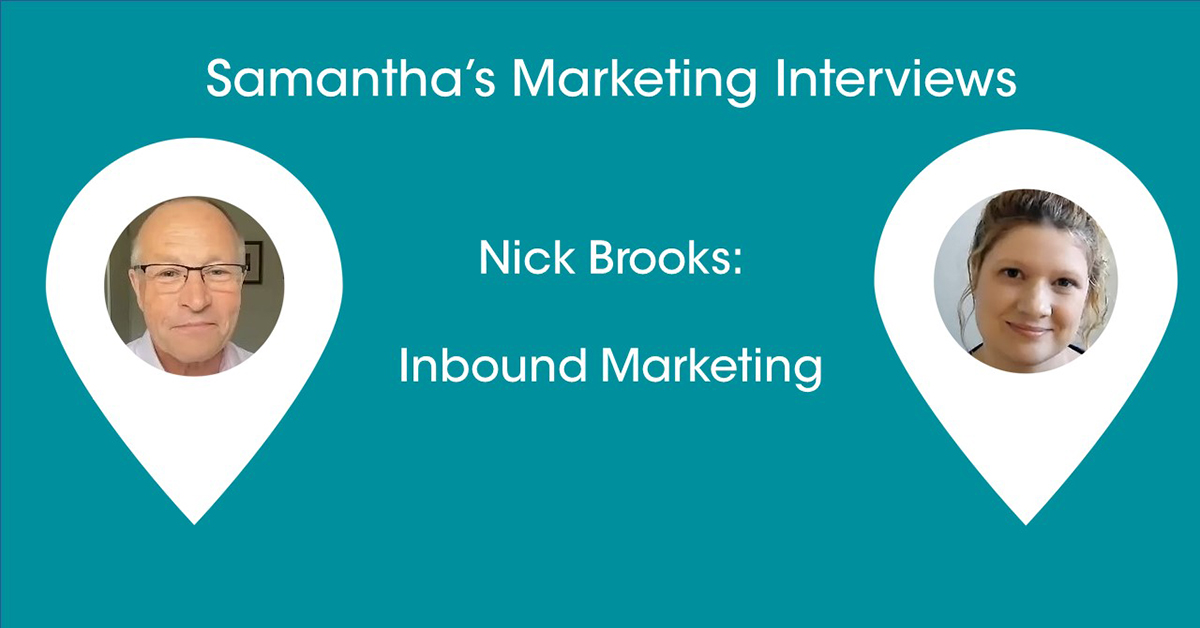
Samantha spoke to Nick Brooks, a marketing consultant with extensive experience in B2B manufacturing & industrial sectors. They spoke about inbound marketing, the importance of the right content, at the right time, in the right format, and so much more. Have you ever wondered about what content might attract more people to your website, and how to convert them to customers? Find out more here!
Nick Brooks, a marketing consultant with extensive experience in B2B manufacturing & industrial sectors.
Nick’s links:
Watch the video here or read the transcript below if you prefer.
Transcript:
Samantha Tonge: Hi. This is Samantha Tonge from Labrakita Marketing again, speaking to another expert in or around marketing. This time, it's Nick Brooks. So, over to you, Nick. Can you give us a bit of background information about you?
Nick Brooks: Okay, yep. Hi. I ran a business-to-business marketing communications agency for about 40 years. We specialised in the manufacturing and industrial sectors. And over that time, I've worked… well we did as a team, with clients large and small. So from small to medium sized companies, small manufacturing businesses, small service businesses, etc., maybe turning over 2, 3, 4, or 5 million pounds through to global multinationals, the likes of 3M, SKF Surveys, etc. So it was a real...
Samantha: Which is exactly why we know each other, because...
Nick: Exactly.
Samantha: Our paths have crossed whilst I was working for one of those big multinationals, Nick was just mentioning. Today we're going to be talking about inbound marketing. Now, not everyone watching this video probably knows what that means. Nick, do you want to do a brief description of what inbound marketing is?
Nick: Okay, fine. All right. Well, perhaps I can start by just putting it into context. If you think about the way we all buy things today, most of us anyway, it tends to be based on online. And when that started, and of course, that process accelerated during lockdown. But when the shift from traditional, if I can call it that, to the online world happened, it tended to be for lower value items: books, CDs, whatever it might be. But now we're seeing the same tendency applying to much higher-value items.
As an example, I’ve recently bought a new car, just before Christmas. I didn't go to a dealer, which I would have done originally in the past. I did all of my research online, decided on the spec I wanted. And it was only at that point, that I then contacted the local dealer to say: "Right, this is what I want, what's the best price you can do?" And the only time I met the dealer is when I went in to collect the car. So I didn't bother with a test drive or anything like that, because I had done my research. And I know enough about cars by now to do that. So that was a sort of 30,000£ purchase or thereabouts. But it can be bigger than that. I remember, a year or so ago, one of our clients won a 6-million-pound order purely and simply through a web enquiry that came through their website. The point here is that, that prospect had already shortlisted this particular company before they even contacted them.
And I think alongside that change in the online buying behaviour, there's also been a decline in the effectiveness of things like cold calling. I'm not saying cold calling is dead, it's just far less effective than it used to be. You know, there's lots of research around but I think that most of the studies tend to show that it typically takes about eight attempts to get through to a decision-maker. And when you do, a very small number of those calls actually revert results in any form of conversion.
Samantha: Unless you happen to catch them after they've already done the research. And they are like: "Oh, you! I wanted to talk to you."
Nick: Yeah, exactly. Yeah.
Samantha: But for that, you need to get very lucky.
Nick: That's right. I think the key thing perhaps is that none of us like being interrupted, you know, and we want to take control of our buying decisions. So doing things online is great, because no sales rep is breathing down our necks: "Buy this, buy this, etc." And it's only when we're ready, that we engage with potential suppliers. And I think this is when inbound marketing comes in. So, sorry for taking a lot longer to get to the answer to your question, but I just thought it was important to put it into context.
Samantha: Definitely.
Nick: So inbound marketing effectively is trying to create an environment, an ecosystem if you like, where people come to you in the first instance, right? I’ll use the 6-million-pound order as an example, that I've just mentioned for a client from a year or two ago. Now, they were very successful at creating this sort of ecosystem online. It was easy for people to find them, easy to understand what they did, easy to understand what they offered and why they should purchase from them. And I think one of the keys to inbound marketing is fundamentally... it's not about selling. I mean, clearly, that's the ultimate goal.
But inbound marketing is much more about helping customers by attracting, engaging and delighting them, really. And you do this with great ideas, insight, inspiration. That's part of what, you know, marketers have always said to clients over the years: "You need to position your business as an authority, as the leading business in this sector, whatever that is, you know, whether it's marshmallows or whether it's industrial sensors, it doesn't matter. We're the company to trust." And this is where inbound marketing really takes that perhaps to another level. So I can't stress this enough: It's about helping, not selling. Because if you help people, provide them ideas and insight, they'll naturally come to you when they're ready to buy.
Samantha: Yeah, yes. So, it's in a way about informing people, right? I guess, back in the day, if people aren't used to the current technology, I guess back in the day, that's what PR was all about.
Nick: In many respects, yeah. Good PR anyway.
Samantha: Yeah. Whereas now, we use different tools: blogs and social media posts... all this stuff. But it is always stuff that's useful, not just "buy my stuff".
Nick: Yeah. I think that's the key thing. And I always used to say this to clients, particularly engineering businesses, because they might have developed a fantastic solution, you know, a great product. And rightly, they're very proud of it, and they want to tell the world about it. But what they always forget is that nobody cares. Ultimately, nobody cares about what you are doing, or what your business can do. What they do care about is the difference you can make to their lives, to their businesses, to their profitability, or whatever it might be. That's the key thing. I don't care that you've got the best Spirit Wrangler, or whatever it might be. What I care about is: Is that going to make a difference to my life, to my business, to my customers? And I think people forget that, when they're selling. Because they're too keen to talk about their own product.
Samantha: Yeah, absolutely. And I’ve had a few clients come to me saying: "I want you to write a blog on this product."
Nick: Yeah.
Samantha: Which isn't always the best approach. I always try and turn that around into: "Okay, so what is the problem that this product is solving? Let's talk about the problem first, and then we can, you know, at the very bottom of the blog, maybe mention what the solution is.”
Nick: Yeah. Yeah, definitely. I think that's right. Because ultimately, if you think about how we search for things online, for example: "How do I change a light bulb?" Or... "How do I... whatever?". It's looking for information. We're looking for answers to questions, because we've got a problem or a challenge that we want to overcome. So you're right, if you're writing your blog posts in a way that answers those questions, that does two things: A) It's great for SEO Search, which is key in an inbound marketing strategy; having good content on your website, so that Google loves it, and you rank highly. And B) it also makes the blog posts much more readable and much more informative to the prospective buyer, your audience.
Samantha: Yeah, absolutely. Absolutely. Because unless you already know that you're looking for a specific product, you're not going to sit there and read a blog about it.
Nick: Yeah, absolutely. Yes.
Samantha: Yeah. So what are the sort of different tools...? If someone wants to start doing inbound marketing, bringing leads in through their website, what are the sorts of tools, especially in a B2B environment, that we need to start thinking about?
Nick: Okay. Well, I think first of all, probably a lot of us are already doing stuff that fits into inbound marketing. You know, a lot of companies are already blogging. They might have a LinkedIn channel or a Facebook channel, or whatever the appropriate social media channels are for their business and their market. But what most companies tend to fail to do is to look at the “Why”. They tend to focus solely on the tactics and so they write lots of blog posts. Great! But why are they writing the blog posts? What do their customers really want?
So the starting point for me really should be: Understand your customers, understand their pains, their challenges, know what makes them tick. Now, where you get that information from is the first challenge, in many respects. If you've got an existing field sales team, then they're probably the source of that knowledge. Because if they're good, then they will know the answers to some of those questions already. And I think here is the pitfall, particularly for larger organisations, where they have a defined marketing and sales department. Quite often, these departments and teams sit in little silos. And I've always said, they should all sit in the same room, or at least talk to each other. Because if you do that, you get much more insight and a much better overall result.
Samantha: It's amazing actually if you develop that cooperation. And it's a topic that I've covered before. It has come up in a few videos, in fact, one of my videos is entirely about this subject, that marketing and sales should work closely together and why. And yeah, certainly, they are a fount of knowledge. Them and customer services as well, because they're the ones talking to the customers.
Nick: Yes. Yeah, good point.
Samantha: And sometimes, you know, you might think: "Oh, this is a great campaign", then you speak to the customer and actually, they have a completely different concern than the one you're talking about. So you need to, as you say, make sure that you actually understand the audience first. I'm really glad you brought this up, you know, that the strategy is of vital importance, because that's my bag. Absolutely. I can't do anything without knowing what your objectives are first. And yeah, if you're going to be an authority, you can't be an authority if you don't actually understand what... well, your customers, really.
Nick: Yeah, absolutely. And I think the other element to it is, is having realistic targets. So you're absolutely right, you've got to understand your marketplace, you've got to understand your customer. Now, a lot of companies will say: "Well, of course we do, we sell successfully to them." Yes, but quite often, they're not selling as much as they could be selling. And they're selling, because there's little competition or whatever it might be. And I would argue, even if you're selling and you're successful, you can always do more.
And often, the key to that is truly understanding, the digging deep, knowing your customers. Because there's another element here, as well. If you're going to a customer and say: "Great, so I'd like to know more about your business. Tell me about your biggest challenges." And they'll say: "Well, quality is an issue or productivity is an issue, or we need to improve the resilience of our IT system from cyber-attacks." Great. If you then press them a little bit further and ask: "But why is that important?" And “Why” is a very lovely word. You know: “Why is that important to you? Why is it going to make a difference to you?” Then you actually start to get beneath, closer to the real reason, by pushing harder and digging a bit more with your questioning. And then perhaps the: “We want to become more productive” changes into the real reason, which is important to them as an individual: "My manager is beating me up, because we have a lot of downtime on our lines and I need to get it fixed." That dressing it up as “we want to produce more”, which is ultimately what they're trying to do, but the reality of it is, they've got a personal issue with their manager and they don't know how to solve it.
Samantha: Yeah.
Nick: I'm not suggesting we stray into HR here, but...
Samantha: I mean, if that keeps coming up… But you know, if multiple sales guys are telling you: “This is the conversation I'm having with our customers”, that is something that you need to be talking to the customers about.
Nick: Yeah, absolutely. Absolutely. And then I think the other element to it from a starting point of view is understand your market. Think about the challenges and pain points, and what they're interested in, what their real needs are, then you can start thinking about developing a content plan. And we can talk about content perhaps in a bit more detail in a minute. But the other element to it is, understanding which customers are the best customers, which customers are your worst customers and understand why. Because what you don't want to be doing is carrying on selling to companies that actually are just a pain in the neck, never really buy as much as they should do, and always haggle on price and try to drive your margins through the floor. What you want is customers that really appreciate what you do as a business, value your products or services, etc. So, it's understanding those different types of customers first, and then really focusing your efforts where they need to be focused.
And part of that as well is doing a proper analysis of your sales figures. Understand things. Simple things like: What are your conversion rates? What's your lead to sale conversion rate, you know? What's your average lifetime customer value? Then tie that back into: What are your business goals? Oh well, you don't even know the number of times I’ve spoken to clients at a senior level over the years and said: "Right, what are you trying to achieve with the business? Where do you want to take it? Where is it going to be in a few years' time? What does your business plan look like?" Worryingly, quite a lot of companies don't even have business plans, particularly smaller ones. That's a separate, big issue. Let's presuppose they do. They'll say: "Well, our target is 10% year on year growth." Great. “Where's that coming from?” “Well, we're going to launch a new product.” “And what difference is that going to make? And if you do launch it, how many sales do you need to achieve in terms of value to give you that 10% year on year growth? What's your conversion ratio? For most companies it's about 25 to 35%. Therefore, how many leads do you need to generate, at what value, etc., etc.” And it's understanding that and having a clear set of statistics, if you like, facts and figures that informs both your business planning, but also can then be fed back into your marketing or sales strategy.
So there's quite a lot you need to do up front, before getting started on inbound marketing.
Samantha: Yes, yes. Otherwise, you can waste a lot of time and money on marketing that's not actually going to achieve anything or not going to achieve what you need it to achieve. It might attract the wrong customers, or communicates the wrong message, whatever.
Nick: I agree. And I think another element to it is as well, which cuts across all marketing really, but particularly drove inbound marketing, is understanding how your brand is perceived in the market, how it's valued. Is it recognised? In many instances a lot of small companies, although they might be very successful, but nobody's ever heard of them.
Nick: You know, there's no brand identity there. And it's all these different factors that come into play with inbound marketing that need to be considered at the outset.
Samantha: Yes. I mean, with inbound marketing, we're talking about lead generation really, but you also need to balance that with brand awareness.
Nick: Yes. Yeah, absolutely. Absolutely. You know, I mentioned the word “Trust” earlier on, when I spoke about positioning a business as an authority, the company you trust, one that you want to do business with. And brand plays a very important part. You know, there are brands we trust and brands we feel ambivalent about, and brands we wouldn't touch with a bargepole for whatever reason.
Samantha: Yeah. Yeah. Absolutely.
Nick: And understanding all of that as well. Besides, if you fall into the latter two categories: never heard of them, don't know much about them, or wouldn't touch them with a bargepole. If that's how your brand is perceived in the marketplace, then you obviously need to start addressing that, across your broader marketing and sales strategies, as well as within your inbound marketing strategy. Because if there are problems, let's say you've got a bad reputation in the market for product failures or unreliable products, then it will take time to change that. I can remember the days in the car world when Fiat, Landseer, and Alfa Romeo had a terrible reputation for rusting faster than average. You know, you looked at them and they fell apart. They've clearly addressed that over the years, because it is no longer what comes to mind when you think about these brands, but it took them quite a long time to change that reputation.
Samantha: Yeah, absolutely. I think in some ways, sometimes it's almost worse having no reputation though. If they've literally never heard of you, why should they listen to you, right?
Nick: Yeah, that's a very good point. And I think the other element to it as well, which cuts across a number of these things, is that we're all working in a very noisy environment, the online space. You do a search for, I don't know, I’ve used: "How do I change a light bulb?" earlier on. You do a search for that, and you'll get thousands and thousands, probably tens and hundreds of thousands of results. Well, how do you make your specific voice stand out? How do you emerge as the leading seller of energy efficient light bulbs amongst all that noise?
And you, as a business as well, might think: “Well, we compete well online with our direct competitors, other manufacturers or sellers of light bulbs.” But actually, you're competing with everything online, not just other sellers. Because we're all being bombarded with messages from all sorts of sources all of the time.
Samantha: Yes, yeah. And I think that sort of connects to what you mentioned earlier, the content plan; finding and presenting the right sort of content at the right stage of the customer journey as well.
Nick: Yes. Yeah.
Samantha: We’re bombarded with so much information and messages every day, even technical people only have so much time. And even their first point of contact probably shouldn't be a datasheet. A real, real detailed datasheet about our products.
Nick: No. Not at all. And sometimes sadly, that's all there is. You know, you go to a company's website and it's all about their products, and attached to each one is a datasheet. Well, great. But it's not really answering the questions that I want answered in most instances. But yeah, a content plan is very important. Once you've done all of that initial planning that we talked about a few minutes ago, I think you're then in a position to actually say: "Right, let's think about the journey the customer goes through, from the point of them having a problem, or defining their challenge to the point of making a purchase." And you can then start to think: "Okay, so what are the things that they can do?" Well, the first thing they're going to do is research online. You know: "How do I change a light bulb?", for example. So, your first content needs to answer those questions.
It's not about: "Hey, we've got a great light bulb", because they're not looking for that at that point. They're looking for an answer to their problem. Once you've done that, then the next stage is to then start leading them down the path towards your particular solution. So that as things develop, the content perhaps becomes a bit more specific to your offering. Equally important in all that, of course, if you've got them as testimonial, a customer testimonial or a case study. Because then again, and this is particularly true for companies that might not have a good, strong brand, if they've got some great case studies on their website, or in amongst their content from customers, that say: "These guys were great in helping us solve this problem", then, as a prospective purchaser, that just gives you a little bit more confidence. Because, you know, chances are, whoever the case study is about, you might be aware of them in your marketed sector, particularly if it’s a bigger brand. Or it might be a small company, but if they've provided a solution for, I don't know, 3M or somebody, then the next potential customer is thinking: "Well, it was good enough for 3M, maybe it's good enough for me." You know, it just adds that little bit of credibility and a little bit more confidence. It's all part of that building that trust picture.
Samantha: Yes. And the other element of case studies is that it’s a story. You've got what I suppose in B2C, people call, social proof, which are kind of similar concepts. But the other thing that's great about case studies is that it's a story. And people engage with stories a lot better than a lot of other content.
Nick: Yeah, definitely. Definitely. And, you know, you've mentioned the blog posts earlier on, that's also a story in many respects. Because, you know, the "Once Upon a Time..." starter is setting the scene. You are talking about the challenge, the problem that people are trying to overcome, and then leading them towards the solution, you know, the happy ending, as it were. And a case study is very much like that. And I think a lot of people tend to think, particularly of my generation tend to think of case studies as being written pieces, nicely illustrated with photographs. Whereas, actually some of the most powerful case studies are in video format these days.
Samantha: Yes. And testimonials as well.
Nick: Yeah.
Samantha: An easy, short testimonial video. Also, I think it's important to have different formats of content.
Nick: Yeah. Totally agree with that. Yeah. Because we all consume materials, content if you like, in different ways. You know, my background is copywriting and written material, so I tend to prefer to read things. But a lot of people, particularly of the younger generation, they're so used to everything being video, that tends to be their first port of call.
Samantha: Yeah, yeah. Yeah. And I think, it also helps embed things in people's minds. If they've come across things in different formats, they're more likely to remember it.
Nick: Yeah, definitely. And I think that's an important point, when you think about the content journey, the type of content that people will need to create. You know, the first thing that they come across might be the blog post on how to change a light bulb. But if there's an associated video with it, that actually shows the process. Great. And I know when I'm looking for things, for example, going back to my car purchase. I was watching reviews online, on YouTube. I was looking for specific content of the particular model that I was considering. And that was great, because some of them were all about the performance, but others were more about the technical aspects of the vehicle, which, you know, both are important aspects of it. And it was very useful. These were quite short: 3, 10 or 15-minute pieces, but that just helps to give you a picture of what you're thinking about buying. And it answers some of the questions you might have: "Is it reliable? Is it...? Is the other wheel going to fall off after 2000 miles?" or whatever it might be that you are concerned about.
Samantha: And that brings me on to something else, because car purchases are kind of famously post-purchase-research heavy, aren’t they? So a certain percentage of people who buy cars, the majority of their research is actually done post-purchase.
Nick: Is that right?
Samantha: It is a sort of confirmation, so they know they’ve made the right decision. And sometimes that’s true in B2B as well.
Nick: Yeah.
Samantha: And it's something that could go wrong, and if it does, it could cause serious problems. So I guess that's another thing to think about in the customer journey, the fact that you need some content for post-purchase as well.
Nick: Yeah, absolutely. And particularly if it's going to be a repeat customer, you know. You might be selling consumables for example and you want them to come back. There's another element to that as well actually, thinking about it... is that I think we tend to forget that when we're selling to people, the person we are in contact with might not be the decision-maker. Quite often once we've gone past the initial stage, once, you've got to talk to the prospective customer, they've gone and done all their online research, etc., shortlisted a potential supplier and they've accepted a call from us, or a meeting, or a visit or in some cases, a Teams call, we tend to think that the person we're speaking to must be the decision-maker. And quite often, I used to see this a lot with different clients sales forces would often take that initial contact at face value. Which is fine, but they wouldn't dig beyond it and they wouldn't try to find out: “If you're going to buy from me, is there anybody else that needs to be in the room that is part of the decision-making process?” And quite often... There was some research done a few years ago by CEB who now I think about it, is part of Gartner, and they found that on average for a B2B purchase, above about $10,000, so not a huge value, there were typically 6.8 people involved in the purchasing decision. Six point eight. I have no idea what point eight of a person looks like, but anyway, we'll park that for a minute...
There were a lot of people involved. So that might be... if it's in an industrial context, the decision-maker might be the engineering director, but he or she is probably going to at least take advice from maybe somebody in quality, maybe somebody in maintenance, certainly somebody in procurements, and so on. So they're going to be influenced by other people around them. This means, when we're selling, particularly if it's a high value product or service, we've got to keep that in mind and think: "Okay, I need to reach out and I need to produce... coming back to our content, I need to produce content for those different people that are involved in that process.” So procurement, they're going to be interested in payback for example, return on investment, total cost of ownership, those types of things. Whereas engineering and maintenance are going to be interested in a different set of criteria. So you need to produce content that works for both, well for multiple parties effectively.
Samantha: Yeah. I've actually got a few clients that have different audiences involved in the purchase of the same product or service and want to produce content for each of them. And they've often got completely different ideas about what's important.
Nick: Yeah, very much so. And coming back to my point about asking “Why”. Sometimes you need to try and speak to all stakeholders/decision-makers to find out why the purchase is important to them, because there will be, as you rightly say, many different reasons. And you've got to find a way of addressing those reasons.
Samantha: Yes, yes, absolutely. Absolutely. So what is...? When you've got all this content… What's the best way to start getting it out there and make sure customers see it? And to then get that content to convert to something that pulls customers back to the website and converts them into an actual, potential customer, an actual lead?
Nick: Yeah. We're back to the manuals now, it's back to traditional or conventional marketing techniques here. Because the marketing toolbox only has so many tools in it.
So I think that we've got lots of channels open to us, in the digital space, as well as the offline space. So we've touched on social media.
Clearly, that's a good one. In the B2B environment, LinkedIn is probably the most common channel, but I don't think you can say it's the only channel. I definitely think that other ones are also used. And we shouldn't lose sight of the fact that while somebody in their professional capacity might be on LinkedIn, when they get home, they might be on Facebook, or whatever the modern equivalent is. So you should also think about those other channels as well. Because with a lot of the Facebook Advertising, etc, you can still define your audience, whether they're design engineers, or truck drivers, or whatever they might be. So with social media, I would say, don't discount anything just because you think it's irrelevant. If you are in B2B, don't discount the non-B2B channels just because you think: "Well, our audience won't be on there." These are human beings you're selling to, they'll be on, you know, lots of these different things. So that's one element. And PR you’ve touched on earlier. Definitely. Use your trade, technical, commercial business media. And if you've got good, informed content, as you brightly alluded to, that makes great PR anyway. You know, most trade publications, those that are left, even today still want good, informed material. They still want people's opinions, they still want solutions to problems, all these types of things. So if you're producing good, solid content that is truly insightful, informative, that helps rather than sells, that, by default, becomes great PR material. If you're using a marketing automation platform, something like HubSpot, for example, then you've clearly got a very powerful... as long as you’ve set that up correctly, you've got the right data, and so forth in that.
You've got a very powerful tool there to reach out to your target audience, either through email, or whatever it might be. And if that's linked into your website as well, even better. Because like all of these things, you need to monitor what you're doing, see what's working, understand why it's working, see what's not working, and understand, just as importantly, why that's not working. And then you can refine and improve, constantly improve. SEO is key, we've touched on that a couple of times. I wouldn't profess to be an SEO expert, but I do know it's a vital part of inbound marketing’s toolbox. And if you've got content, you can use it in trade shows, you can use it in offline events as well.
Samantha: Yeah. Don't forget face-to-face.
Nick: Absolutely. And whether that's video, that you can have running on a TV monitor on your exhibition stand, or if it's a bit more detailed content, like you've run a webinar or something of that nature. Usually, the content for that webinar makes great material for a face-to-face presentation. Most trade events, and most exhibitions will have breakout areas where companies can go and talk about a particular topic. If you've created good, solid content in the form of a presentation or webinar, it's easy to adapt that for a seminar or a conference presentation.
Sorry, I've probably missed a few things. But I would say, basically, all of the traditional, conventional marketing channels are appropriate for pumping your content out there.
Samantha: Yeah, yeah. And I think people think that email and social media is free, especially when it's organic social media as opposed to paid for. Therefore, that's what they should be focusing on. But it's not truly free. It takes time and effort to do it correctly.
Nick: Yeah.
Samantha: And it's not always the right channel, or at least it's not the only channel which you should be using. You should be going to wherever your audience is, which, you know, is not just social media.
Nick: Yeah, yeah. That's right. And even on social media... I mean, yes, you've got the organic posts, but don't discount paid posts either, because they can be just as effective. Particularly, if you've got a good content, what I would call a content asset, i.e. a good, solid document, like a white paper or a good video, you know, a good "How to" or training-type video, that can be promoted very effectively using paid posts.
Samantha: Yes, yes, I agree. And if you've got a really solid message, that's about what your core audience really cares about. I mean, I've got great results from LinkedIn Advertising particularly. A lot of people dismiss it and say: "Oh, I've heard it's really expensive, or it doesn't do very well". But if it hasn't been doing very well, it's obviously not been done right. So it goes back to making sure that you get the foundations right in the first place. And you shouldn't be thinking about it in terms of cost, you should be thinking about it in terms of return on investment.
Nick: Yes.
Samantha: And the return on investment can be excellent. I've seen some amazing results from it. So yeah.
Nick: I think, in the B2B space, people have certain expectations. If they do some advertising, whether it's Google Ads, LinkedIn Advertising, whatever it might be, they think: “What a haul it's going to be”; they expect to have loads of responses. While, actually, for most manufacturing, industrial, B2B-type businesses, as they often work in quite niche markets, that might not be the case, and often it shouldn’t be the goal.
You can promote a really good asset on LinkedIn, and you might only get 20 or 30 downloads of it, but if they're the right downloads, you know, then it is worth it. I remember, we ran something a couple of years ago for a company who was selling into the water industry. There was a particular topical issue around phosphates, as I recall, at the time. We produced some really solid content around that, talking about the problems, etc., etc. We promoted it hard, specifically through LinkedIn, and specifically to the key decision-makers in the water companies. And we only got maybe, I can't remember what it was, maybe 25 or 30 downloads. But amongst those were a number of the key decision-makers and the company ended up selling to them as a result. So it's about quality, not quantity. That's the key thing. And coming back to your return-on-investment point of view. Yes, the LinkedIn Advertising cost them, I don't know, probably a few hundred quid or something like that. But each sale had a value of 5 to 10,000 pounds upwards.
Samantha: If you spend £700, and you get £20,000 sale out of it, you shouldn't be worrying about the £700 you've spent.
Nick: No. And you know, if you think about it, a lot of people in the B2B marketplace are old enough to remember the days of print advertising. In those days, if you wanted a full-page ad in a trade publication, it was £1,000, £2,000, sometimes £3,000 per page. So why are we now quibbling about spending a few hundred pounds on LinkedIn? The sense of perspective seems to have gone.
Samantha: And with that full page advertisement, there is a drawback, because you don't really know who's seen it, or you can't drill down to the same level that you can in LinkedIn. Again, we're talking about those audiences with differing priorities in mind. You might have three adverts: one for your purchasing guys, one for your engineers, one for their managers. And you can drill down and make sure that they see what you want them to see with LinkedIn. That's the other benefit over print. And I, by no means, intend to discount print, at all. Sometimes that should definitely be part of the mix. But with these platforms, you know that the right people are going to see it. That's the beauty of it.
Nick: Yeah.
Samantha: Same with Facebook, you can get really granular with who you want seeing it. And the same is true of LinkedIn, you can select identifiers like: seniority, you can get the right job types, the right industry, the right company sizes. It's quite impressive what you can do with them.
Nick: Yeah. Yeah. Definitely. I think there's another factor that's worth considering here, most of us make this buying decision emotionally.
I know I did. I'm a bit of a gadget freak. So, you know, I'll see something bright and shiny and think: "Oh, I like that, I want that." And then I'll justify buying it, I'll rationalise it afterwards. And this is the way the brain works. You know, you've probably heard of system one and system two: fast and slow thinking, and so forth.
According to this theory, the emotive bit sits on the fear and flight path, going back to when we were all Stone Age people. And it's a much faster decision-making process.
The rational part of the brain is much, much slower. So we tend to make decisions quite quickly for all sorts of reasons. So when we're advertising or thinking about our LinkedIn Advertising or indeed our social media post, you've got images attached to that. My advice: don't show a product picture. You know, that's the next best thing to murder it on, for most people. Think about something that's going to capture their emotions. And it doesn't have to be a Formula-1 car or a jet aircraft or whatever, it's trying to find a way of engaging your customers’ emotions, so that they look at it and there's that instant connection. And then they're more likely to click through.
And I think particularly in the B2B environment, we tend to end up with an awful lot of very dry images. They might be beautifully, technically pro photographs, but they're very dry, dull, and boring and conduct my point on their own. I used to say to clients: "Nobody cares about what you do. Nobody cares what your product looks like. Not to start with. They might ultimately, but they weren't to start with."
Samantha: Yes, I think there's this myth, especially in the B2B world about technical people, that when you talk to technical people, they're very rational. It's very dry, and they shouldn't be dealing with emotion. And it's completely... that's not true at all. It might be a different set of emotions that you need to think about, if they're very technical people, but they’re still human beings, and therefore, they are emotional beings too. And you do need to touch on that to get their attention. It's not about, you know, what's keeping you up at night. Although sometimes you need to talk about the fact that something's keeping you up all night.
Nick: Yeah. Absolutely.
Samantha: And that's something that I did. One thing when I work with clients when I'm doing a messaging workshop is to: "Okay, we’ve figured out what their problems are, we’ve figured out, you know, what's special about you, what the crossover is, what your brand proposition is. Now, what emotions do we need to be thinking about when we're creating content?" And that's really powerful, I think.
Nick: It's akin to, if you think back to good, successful salespeople you’ve known over the years. When they meet customers, or prospective customers, they're the ones that spend time building rapport with the customer. They don't come in and suddenly start chatting about their product.
What they do is, they come in and start talking about the customer as an individual. I mean, and I'm not talking about the classic: "Oh, where are you going on holiday?"-conversation, you know, it's a little bit more subtle than that. But good salespeople are very, very good at building rapport. It's only when they've done that, and started to get a good feel for the individual, and what their challenges are, etc, etc, that they might eventually get around to saying: "Oh, well, we've been chatting for half an hour now, we got a cup of coffee, maybe I better tell you why I'm here, which is to tell you all about my product or service, or whatever it may be." But they spend a lot of time digging beneath the kind of psyche of the individual customer. So, you know, what you were just saying is kind of akin to the traditional sales process, a good sales process anyway.
Samantha: And again, sales and marketing should be aligned.
Nick: Yes. Absolutely. Absolutely. There is no point sending out marketing messages that are contrary to what your salespeople are talking about when they go and talk to a customer. Or making promises... marketing can sometimes end up making lots of promises that the product can't keep, or the service can't meet. And then the poor old sales team is in a pickle. The customer will say, for example: "Oh, I saw this advert of your product the other day on LinkedIn. It says that it can do X, Y and Z." And the sales guy is thinking: "No, it can't. Or it can only do it in perfect laboratory conditions."
Samantha: Yes.
Nick: So this is again, a reason why sales and marketing need to talk to each other, you know. Because marketing might get a brief to promote a new product: "We've got to launch this new product. And these are the features and benefits, etc." Great. So they come up with a great campaign, but it doesn't resonate with the messaging the salespeople are then putting out into the marketplace. And sometimes, by working early on, on that brief with a new product launch. By working together, sales are in a much better position to say to marketing: "Ah-ah, that's the wrong route to go down. If you go down that route, nobody's going to take any notice." Because what's really important to customers is not the fact that this product is 50% smaller or whatever it might be. What is important to them is that it can respond far quicker, therefore, the customer's product quality is going to be better, or whatever that outcome might be.
Samantha: Yeah, yes, yeah, absolutely. Absolutely. So is there anything else that we should touch on, talking about inbound marketing? I know we've mentioned marketing automation, but I don't think that everyone watching this video will know what that is. Is that something we should maybe briefly elaborate on?
Nick: Yeah, I mean, I mentioned HubSpot. HubSpot is a great product. But it's one of many marketing automation platforms. I know HubSpot quite well, so I'll talk about that one, if I may. But what I'm going to say about HubSpot will apply to Pardot, Marketo, etc. So, it's a modular product which consists of a marketing module, sales module, and if you need, a customer service module. So you've got an integrated platform that can handle basically all of the customer journey, from the initial point of: "I've got a problem" to sale and beyond. The beauty of something like HubSpot, or any of the other products is that, as the term implies, it allows you to automate a lot of things. So I'm sure most people will have gone online, made an enquiry about something and instantly, or almost instantly in their inbox a thank you email popped up, saying: "Oh, if you're interested in this, then you might also like to look at blah, blah, blah". And then a week later, you get something else. And if you click on one particular link, you get something that says: "Ah, if you're interested in this, then you might also be interested in that." That's all part of the automation function. Now for a lot of companies, that can be an overkill. You know, HubSpot, and all these other platforms are not particularly cheap.
Samantha: Some of these are very expensive.
Nick: They are. Yeah. And there are a lot cheaper tools out there that are more kind of, basic email marketing tools. And I'm not so familiar with those, but there's a lot of them out there. I think MailChimp is quite widely used, isn't it?
Samantha: Yeah. And I think in-between is like ActiveCampaign. I think it was $70 a month or something. It's something between your HubSpot and your MailChimp.
Nick: Yeah, yeah. So there's quite a lot of tools out there, I think each company has to look at these on their merits and decide on actually what's most important for them. And sometimes it's worth starting at the low end, testing it, just doing some email marketing, maybe link it into your website, if you can. See how it goes. Develop your skills. And then as time goes on, and your skill levels improve, and the needs change, and you can see more potential from automating more. You can then say: "Right, let's move from Product A to product B." Or if it is one of the scalable ones, and there are some... even HubSpot is scalable, isn't it? I think there's an entry level module, which is free, just on the marketing side.
Samantha: Yeah. That is available.
Nick: You can then upscale. Yeah, yeah, that's right.
Samantha: Same with MailChimp, I think they've got a free version.
Nick: Right.
Samantha: So you're saying, people should start off small and build it up?
Nick: Yeah.
Samantha: And it's great for saving time as well. It's not just the cost you've got to look at here. It's also how much time automation is going to save you.
Nick: Yeah, absolutely. Yes. Because it might be, you know, $500 a month or something, but if it saves you two days a week...
Samantha: Yeah. It is valuable.
Nick: Yeah.
Samantha: Yeah, if it means your sales guys have more time to be out in front of the customer, instead of sitting there at their desk doing the paperwork, then...
Nick: Brilliant. Yeah, and a lot of larger organisations will be using something like Salesforce. Salesforce, I think, has probably got its own marketing tool as well. But it will also integrate quite well with HubSpot, Marketo, and some of these other platforms. So, you know, if the sales team is already used to using something like Salesforce, then bolting on a marketing automation system around it is relatively straightforward. And if they're using Salesforce correctly, they've got the sort of mindset of keeping things up-to-date, and using the information that's in there.
And it's a great tool, because, if you use a product like this, it can also help you score your leads. So basically, you can look at the individuals and say: "What interaction have they had with my business online? Okay, well, I can see through HubSpot, or whatever, that they've looked at these six web pages, and the six pages are all product-related, or they're really interested in this particular area of application, aerospace, or whatever." So that when the time comes for a salesperson to have a conversation with them, they can look at those levels of interaction and think to themselves: "Right, I'm not starting this conversation with this prospect cold, because I can see that they're interested in aerospace, I've looked at their own website", which should be a default, but it doesn't always happen. "I can see they're in the aerospace sector. Great. I can see that they're manufacturing for the MOD or something, therefore, I know they're going to have potentially procurement challenges or whatever it might be." And you can then relate that back to what they're doing on your own website, or social media channels, the downloads they may have made, the videos they may have watched. You can use that to inform the conversation that you open with, with the prospective customer so that you actually make it sound like you know about their business.
Samantha: Yes. And not saying: "Oh, I see you've done X, Y, and Z on our website…"
Nick: No. That's a bit creepy.
Samantha: They'll feel like they are being watched. But you should have an idea. And I also think something that you've mentioned, the lead scoring is very powerful in my experience. Most of these systems can have an alert set up, so if they hit a certain score, based on their interactions, for example if they clicked on an email or, you know, downloaded white papers, etc.,. If they then hit a certain score, the alert can go through to the relevant salesperson who can pick up the phone as if it was a cold call: "And have you heard about this stuff, (that we already know you're interested in)?”
Nick: Yeah, absolutely. Yeah, And I made the comments earlier on, right at the beginning that although I'm not saying cold calling is dead. But I definitely think that It's just not as effective as it used to be.
When I was running the agency, I was always flabbergasted at the number of people that would call and try to sell something to us, who hadn't done the basic research.
So for example, we were in serviced offices. It was a big block of offices, all of them serviced in there. You know, it was known locally for being serviced offices, and yet we'd always get calls from people trying to sell us office furniture or telephone systems or whatever it might be.
Samantha: Yeah. Yep. I get that.
Nick: Yeah. So they never even got through to me. In fact, if they had done their research properly, they would have known that I had an Operations Director and she handled all of that sort of stuff. So they should have been ringing her anyway, not me. But you often find that people will try and sell you something that you don't need because they've not done their research properly.
Samantha: And why...? I get people trying to sell me what I do. All the time.
Nick: Yes, that's even more bizarre, isn't it? Yeah. But if they were ringing you and saying something like: "I can see you're a small business. Your time is obviously valuable to you. Can we help to free up some of your time, perhaps by taking some of your workload off you, so that you can focus more on the parts of the business where you can add greater value to your customers, etc.?" Maybe that would be more of a conversation.
Samantha: Yeah. Yeah, exactly. Exactly. And it comes back to doing that foundation work in the first place.
Nick: Yeah, absolutely.
Samantha: Where this ties in is that it's invaluable to sales guys. They've got all this information, they already know certain things.
Nick: Yeah. Yeah.
Samantha: And that's another thing to think about besides nurturing leads. The other thing we've mentioned is automation. And you can have it set up to do certain things based on different behaviour. You can have different email flows, and so on. Even MailChimp does email flows, where, you know, if you clicked on this, send them this email, if they haven't, send them that email. That kind of thing.
Nick: Yes. Although that's very much an either/or-type of approach. Yeah. And I think you're right about different content at different stages. We've talked about the customer journey, but you can reflect that in your marketing automation system. I'll stick with my light bulb analogy: "How do I change a light bulb?" And if somebody has downloaded a piece of content, or read a blog that tells them how to change a light bulb, they're probably at the early stages. So then you need to think about: “What do I follow that up with?” Perhaps you give them something else that reinforces the message about light bulb changing, or maybe it says to them: "Okay, so now you know how to change a light bulb, did you know there are all sorts of these different light bulbs? You can get an LED one, a halogen one, or this, that, and the other one?" Whereas somebody who has downloaded a product data sheet for example, is probably a bit further down the customer journey. So they might need a different type of content. You know, they might need the case study that actually says: "Learn how customer X has been using our Product 12345 to improve their life, productivity, quality, whatever." So yes, and you can do all that in the marketing automation system. But you've come back to something you said a few minutes ago, you've got to do your due: your planning, your research and your understanding up front.
And I'd add to that. Just because you've done all that, gone through that process once, don't think it's finished. It's constantly evolving, people will change, customers change, clients change. So you've got to go back and revisit that from time to time.
Samantha: Yes. I actually use a process called SOSTAC. There are loads of different ones out there, but I use something called SOSTAC.
Nick: Right. Yeah.
Samantha: And the last letter in that one stands for control. It's not a linear process, it's a circle. First of all, in situations (S)... which is very much what we were talking about, make sure that you've done your research first. O - Objectives. Know what it is you want to achieve. S - Strategy, T - tactics, A - action. And then the last one is control, which is all about what's worked, what hasn't, what has changed, and then you go back to the situation again.
Nick: Right. Yeah.
Samantha: And it's a continuous cycle. You know, you should always have plans. You need your 3, 5, 10-year plans, but you also need to have your 1- and 2-year plans, and even within the year, check what's working and what's not.
Nick: Absolutely.
Samantha: And just... yeah, as I said, keep in mind that it's a continual thing.
Nick: Yes. And I think the challenge for a lot of people is that they accept the status quo. As in, the status quo bias, I don't mean, for those that can remember them, the band.
Samantha: Yes.
Nick: You know, what we've been doing for the last six months has now become the norm, it has become the status quo. We've changed what we were doing six months ago, now, it's become the status quo. It's working OK, we're happy. But what they never do is go back and revisit it and say: "So, we've now been using it for six months, what can we do now to make it better, to improve it?" You know, other priorities come along, and we get side-tracked. And this can be one of the challenges as well, of course, if you're trying to sell to those sorts of people, or market to those sorts of people that are embedded in the status quo, because it's very hard to change their mind. So you've really got to have a compelling offer, which comes back to understanding the market and all the other things we've talked about.
Samantha: And a lot of people have a bit of a fear of change.
Nick: Oh, without a doubt.
Samantha: And they are more thinking about what could go wrong than what they're missing out on sometimes.
Nick: Yeah, there is a stat, I can't remember who, I think there's a guy called Daniel Kahneman. And he did some work, but he concluded that people are 2.5 times more risk averse. So basically, if you want somebody to change, and what you're offering them is potentially, to them, risky, you've got to be able to demonstrate an improvement in whatever it is, at least 2.5 times over and above what they're already doing, before they'll even consider changing. People are risk averse by nature. And, you know, trying get people to change away from the status quo can be very, very difficult.
And there's also the other element. There's a bias, I can't remember what it is called, but it's basically where: "Because we've already invested our time and energy in this new solution. I'm not going to consider anything else, simply because I'm too heavily invested in it, even if it's not working." It's called a cognitive fallacy.
Samantha: My dog is trying to break out of the office. I'm sorry if you could hear. I think he's heard something interesting in the other room; I think my other haf's got a snack or something. But that's really brilliant information. Thank you so much.
Nick: You're welcome.
Samantha: And before we go, have you got anything to plug, anything that you'd like to let people know about?
Nick: Well, I’ve mentioned that I ran the agency for 40 years, I'm now working as an independent marketing consultant. I specialise in working with smaller, industrial, manufacturing businesses, SMEs, who may lack internal marketing expertise, and need some help strategically. But also, I do a lot of technical copywriting. So you mentioned blog posts earlier on. I do a lot of, what I would call, technical blog posts, white papers, case studies, all those types of things. And we’ve sort of touched on it already, haven't we? People are very busy, and sometimes, you know, although they can write the materials themselves, it might actually be more cost-effective to give it to a specialist. Someone, who understands the technology, understands the subject, can turn it around in a reasonable timeframe. It can then go online, job done, you know, and they can focus on other things. So yeah, I'm working as an independent consultant for across a number of areas, but fundamentally manufacturing businesses.
Samantha: Brilliant. Okay. Well, I will be putting Nick's links on the website, where I will be hosting this. So check that out. And yeah, brilliant. Thank you very much, Nick.
Nick: You're welcome. Thanks very much.
If you need help with your B2B marketing contact Nick on +44 (0)7970 242748, or at nick@nick-brooks.co.uk or contact me on 07791 521439 or email me at samantha@labrakita.co.uk
Interviewer: Samantha Tonge, Managing Director, Labrakita Marketing